Pumptracks and Public Procurement: Understanding the Challenges of Design-Build Contracts

As explained in our previous article on market sourcing, the success of a pumptrack project begins with clearly defining the project’s requirements.
Once this stage has been completed, local authorities must choose the procurement procedure best suited to their project. Should design and construction be awarded under separate contracts? Should a design-build contract be considered? Is there a universal answer to these questions?
At HTracks, we believe this topic deserves a technical, pragmatic and balanced approach.
A Facility That Has Become Much More Than a Sports Infrastructure
Over the past several years, local authorities have increasingly invested in pumptracks to meet growing public demand for sports facilities, active mobility and outdoor recreational spaces.
Today, pumptracks are used by a wide variety of people: young children on balance bikes, BMX riders, skateboarders, scooter riders, inline skaters, beginners and experienced athletes alike, as well as many casual users.
Despite its apparent simplicity, a pumptrack is now a highly technical facility whose success depends as much on the quality of its design as on the precision of its construction.
The Principle of Separating Design and Construction Also Has Exceptions
French public procurement law establishes a general principle of separating design services from construction works.
However, the Public Procurement Code also provides several situations where a design-build contract may be justified, particularly when technical considerations require the contractor to participate in the design phase of the project.
Design-build is therefore a procurement method specifically provided for and regulated by the Public Procurement Code. Its use must be assessed on a case-by-case basis and properly justified by the contracting authority.
A Pumptrack Is Far More Than Simple Earthworks
To an untrained eye, a pumptrack may appear to be nothing more than a series of rollers and berms.
In reality, it is a highly sensitive structure where even a few centimeters can significantly affect speed, flow, accessibility, riding comfort and user safety.
The actual performance of a pumptrack depends on several key factors, including:
- the geometry of the riding lines (curve radii, transitions, etc.);
- the quality of the earthworks;
- stormwater management;
- the materials selected;
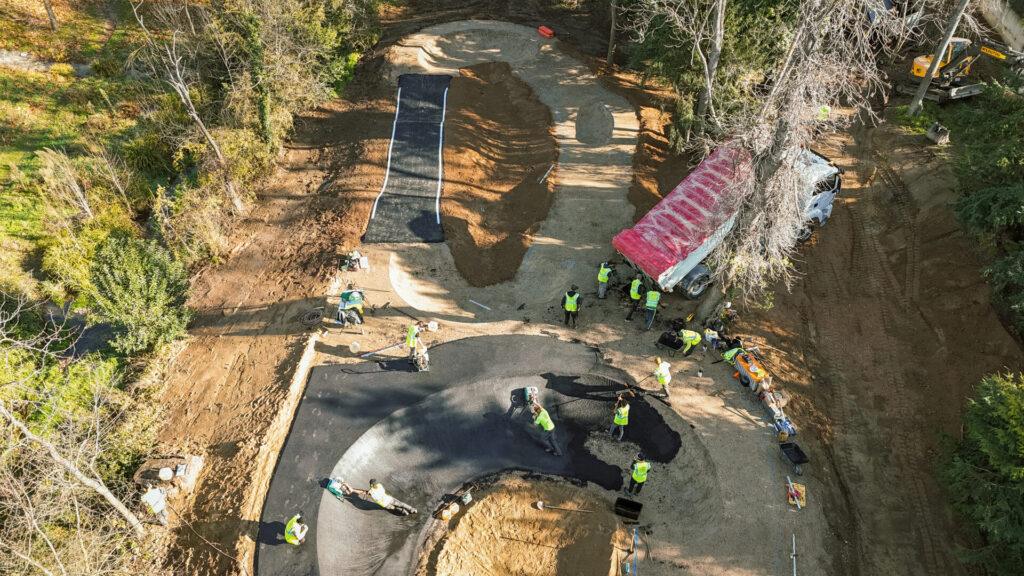
- and, above all, the quality of the asphalt installation.
A well-designed track is not necessarily a well-built one. Likewise, even the most skilled construction teams cannot compensate for a poor initial design.
The final performance of the facility therefore relies on continuous interaction between the design process and on-site construction.
Designing a pumptrack requires technical expertise, but also a deep understanding of how riders actually use the facility. This is essential for infrastructure intended to be ridden every day.
Understanding user behaviour is therefore just as important as mastering construction techniques.
Why Some Local Authorities Choose Design-Build
Today, some municipalities choose the design-build approach not because it is easier, but because they are seeking:
- overall technical responsibility through a single contractor;
- continuity between the design phase and construction;
- greater control over the final result.
On this type of project, adjustments during construction are common.
Site conditions, drainage constraints, finished elevations, connections with existing infrastructure or fine adjustments to riding profiles often require modifications during construction.
When design and construction are completely separated, managing these adjustments can become more complex.
A design-build contract helps ensure technical continuity throughout the entire project.
An Integrated Design Office: Ensuring Continuity Between Design and Construction
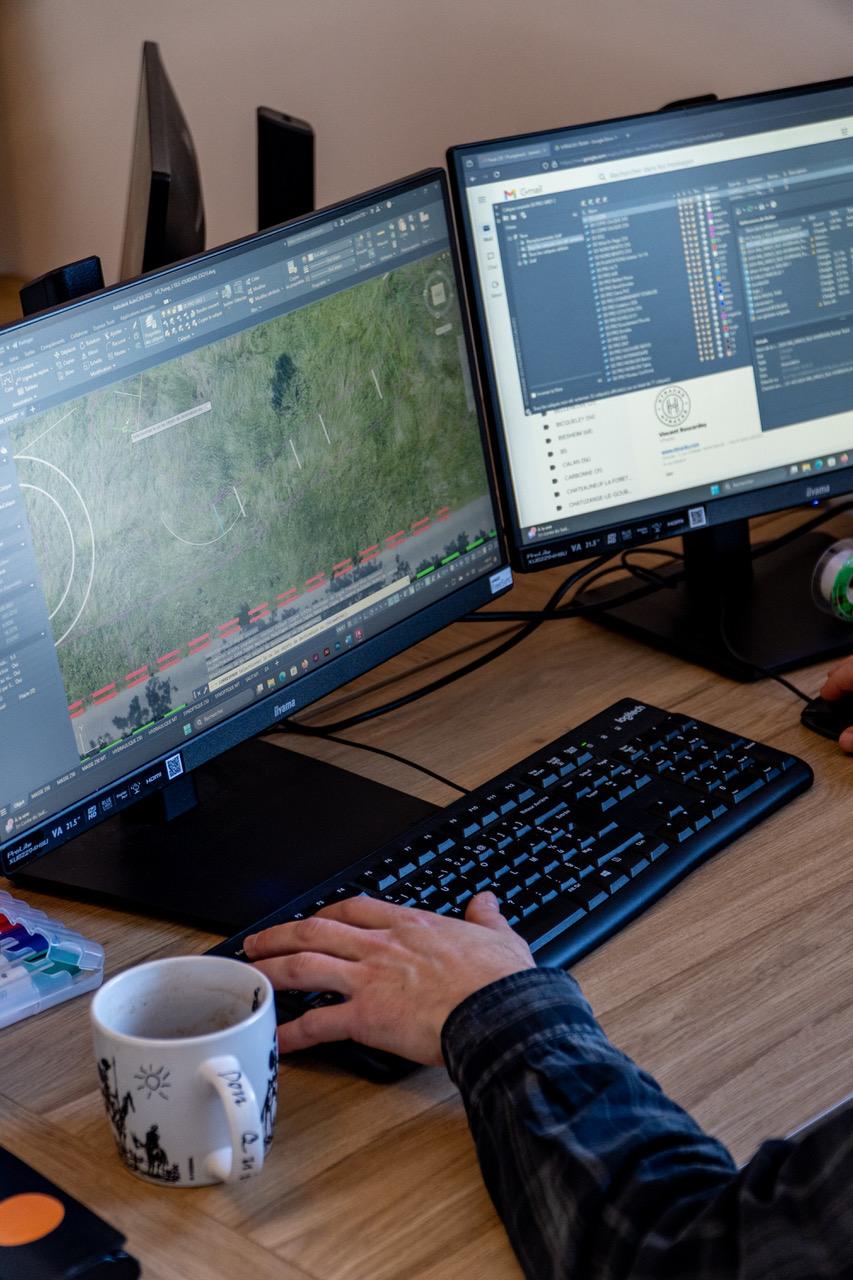
Many specialist companies now have integrated engineering departments that provide this continuity.
At HTracks, our engineering team works daily alongside our construction crews.
This collaborative approach bridges the gap between theoretical design and on-site reality, ultimately improving the quality of the finished facility.
However, project quality does not depend solely on the procurement method.
No procurement procedure, by itself, guarantees a successful project.
A poorly designed pumptrack can result from either a design-build contract or a traditional design-bid-build approach. Ultimately, success depends on the quality of the project brief, the experience of the professionals involved, the expertise brought to the project and the quality of project management.
Reducing the debate to a simple opposition between a “good” and a “bad” procurement procedure would therefore be an oversimplification.
An Approach Based on Expertise and Transparency
The current debate surrounding pumptrack public procurement highlights one important reality: local authorities are seeking greater technical rigor, transparency and legal certainty.
This is a positive development.
At HTracks, we believe every successful project is built on three fundamental pillars:
- technical excellence;
- legal certainty;
- the best interests of future users.
In some situations, separate design and construction contracts are perfectly appropriate. In others, a design-build approach provides greater overall consistency throughout the project.
The real question is not which procurement procedure is systematically better, but rather which one will deliver the highest-performing, most durable facility that best meets the needs of both the local authority and its community.
Every project deserves its own analysis. Every local authority should have access to all the technical, legal and operational information required to make a fully informed decision.
Sources: Articles L.2431-1, L.2171-2 and R.2171-1 of the French Public Procurement Code.