
Pump Tracks and Sustainability: A Durable Sports Infrastructure



Designing pump tracks for long-term sustainability
Environmental considerations are now central to most public development projects. Cities must evaluate the environmental impact of new infrastructure, anticipate maintenance costs and limit unnecessary land development.
In this context, pump tracks offer an environmentally responsible solution with several measurable advantages.
A properly designed asphalt pump track can last more than 25 years while requiring minimal maintenance, typically limited to occasional cleaning and routine visual inspections. Unlike metal structures or facilities with complex mechanical systems, pump tracks do not require permanent lighting or mechanical maintenance.
Less maintenance also means fewer heavy interventions over time and a lower carbon footprint across the life cycle of the facility.
Materials and construction: key environmental choices
The environmental impact of a pump track begins at the construction stage.
At HTracks, the design and construction process prioritizes:
- up to 90% recycled materials
- 95% of materials sourced from local quarries
- strict sorting and management of construction waste
This approach significantly reduces material transport and the associated carbon footprint. Studies in the construction sector show that the extraction and transportation of materials represent a substantial share of emissions in public works projects.
Through specialized partners, HTracks can also provide project owners with a detailed carbon footprint assessment and propose compensation measures when necessary.
These are measurable indicators, not simply environmental intentions.
A low-impact infrastructure in everyday use
A pump track operates without energy.
There is no mandatory lighting,
no engines,
no electromechanical systems.
It is a passive infrastructure based entirely on terrain shaping and body movement.
In many public facilities, the operational phase represents a significant portion of environmental impact. The simplicity of a pump track therefore becomes a strong sustainability advantage.
Encouraging active mobility
The environmental impact of a pump track is not limited to construction, it also relates to how the space is used.
By encouraging cycling, BMX riding and scooter use, pump tracks align with broader policies promoting active mobility and outdoor physical activity.
The World Health Organization has repeatedly highlighted physical inactivity as one of the leading preventable health risk factors worldwide. Infrastructure that encourages movement without relying on energy-intensive systems plays a meaningful role in addressing this challenge.
Integrating and revitalizing public spaces
Designing a pump track is not about installing a standardized structure. It begins with a detailed reading of the site.
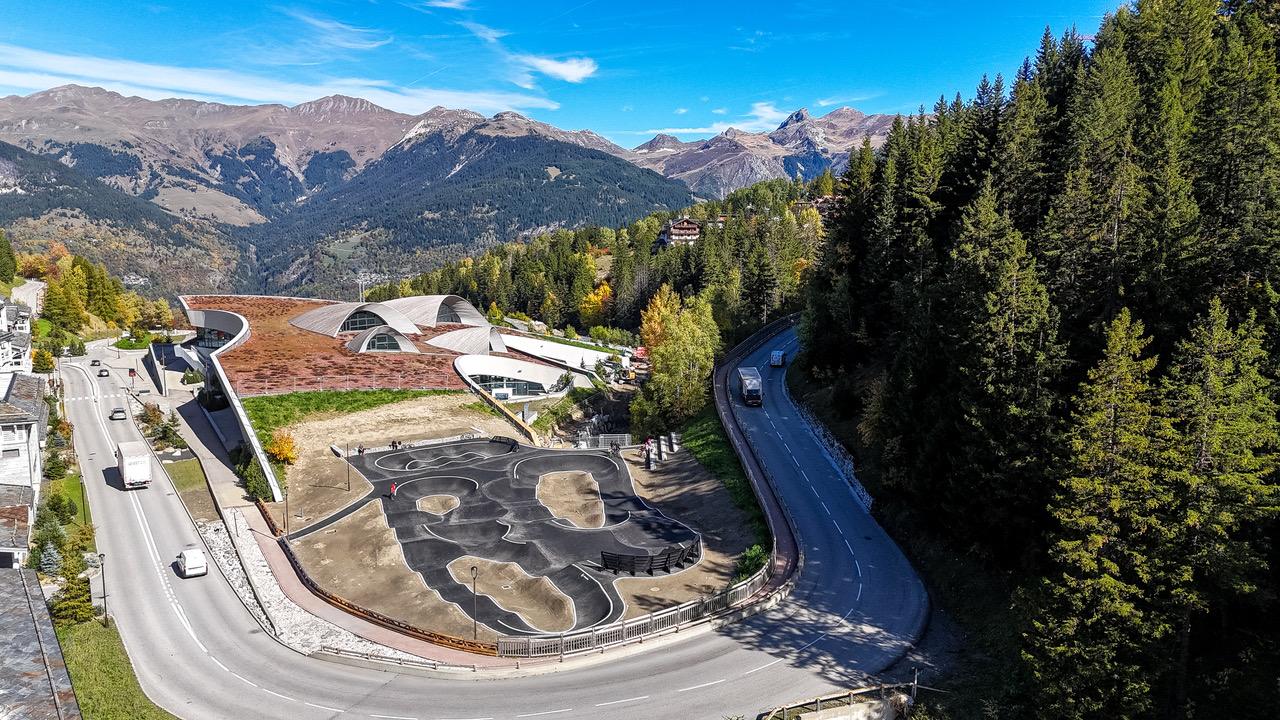
By optimizing earthworks and working with the existing terrain, a pump track can transform an underused space or vacant lot into a dynamic community asset, without introducing large structural elements or heavy construction.
Designing efficiently, using recycled materials, minimizing maintenance and integrating the track into its surroundings: this combination is what makes pump tracks particularly relevant in the context of today’s environmental challenges.