Pumptracks and Public Procurement Who designs, who decides, who builds?
When a public authority wants to build a pumptrack, there are several ways to structure and manage the project. At first glance, these differences may seem primarily administrative. Yet the chosen procurement and project structure can have a direct impact on the quality of the pumptrack that is ultimately built.
To understand why, it is important to first distinguish between three roles:
The client, the design team and the contractor.
The client: the one who leads the project
The client is behind the project and defines its objectives.
For a public pumptrack, this is usually a municipality, an intermunicipal authority or another public body.
It defines its needs: for example, it may want to build a pumptrack on a specific site, with a given budget and specific objectives.
The client is responsible for the project, secures its funding and makes the main decisions.
The design team: the one who designs it
The design team is responsible for turning the client’s needs into a financially and technically feasible project.
This may be an architect, landscape architect, engineering consultancy or a team bringing together several areas of expertise.
Depending on the scope of its mission, the design team may design the project, produce plans and technical documents, estimate the cost, prepare the tender documents and then monitor the execution of the works.
For a project involving several facilities — pumptrack, skatepark, sports fields, pathways, green spaces, lighting, etc. — this organization makes perfect sense.
The design team is then responsible for ensuring the overall consistency of the development.
But a pumptrack has one particularity: its quality depends heavily on an understanding of the sport.
A few dozen centimetres, a curve radius, a slope, a sequence or a transition can completely change how a track behaves, call into question the layout of the surrounding facilities and have consequences for the project as a whole.
An excellent architect or landscape architect is therefore not necessarily an excellent pumptrack designer.
The contractor: the one who builds it
Once the project has been designed, the client can launch a works contract.
Contractors then submit their bids based on the documents prepared by the design team.
In a conventional structure, this gives us:
Client – Design team – Contractor.
For many types of projects, this system is highly effective.
For a highly specialized sports facility such as a pumptrack, however, it is essential to ensure that specific expertise is present from the design stage onwards.
Another approach: combining design and construction
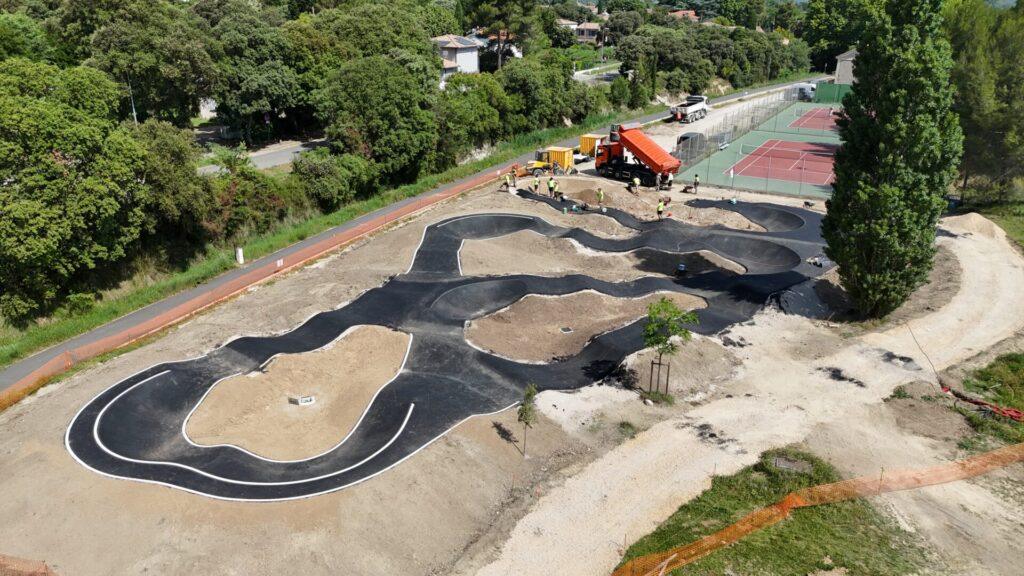
There are also procurement structures that bring these skills together more closely. This is known as a Design-Build contract.
The idea is simple: a specialized contractor can bring its expertise and field experience into the design of the track, rather than simply having to build a project that has been fully defined beforehand.
For a pumptrack, this can be particularly valuable because design and construction are closely interconnected.
This does not mean that a contract separating design and construction will necessarily result in a poor pumptrack.
The real issue lies elsewhere: who has the pumptrack expertise at the time the key decisions are made?
Why alternative proposals can become important
When a pumptrack project has already been designed as part of a design assignment, specialist contractors may sometimes identify potential improvements.
Curve dimensions, lines, trajectories, difficulty levels, rider flow, making the most of the site’s topography: their experience may lead them to propose a different solution.
Depending on the procurement framework and tender documents, alternative proposals may allow bidders to put forward an alternative solution.
This can be highly valuable: the client retains a clear framework — site, budget, program and constraints — while allowing specialists to contribute their expertise.
Conversely, when a contract imposes a very precise layout and leaves contractors no meaningful room for adaptation, they essentially have to price and build what has already been designed.
If the initial design is not right, it becomes much more difficult to correct it.
Price is therefore not the only issue
Two pumptracks with the same surface area and the same budget can provide radically different experiences.
A successful pumptrack must work for different skill levels, offer interesting lines, maintain flow and rhythm, and remain fun and attractive after hundreds of rides.
A client looking to create a showcase facility should therefore consider not only who will build it, but also who will actually design the sporting component.
Specific expertise can be integrated in different ways: within the design team, through a specialist working alongside it, or through a structure that allows specialist contractors to contribute to the design.
One simple question to ask from the very beginning
Before even discussing brands, contractors or technical solutions, the client can ask one simple question:
“Who, within our project team, has the expertise required to design a durable and functional pumptrack?”
If the answer is clear from the outset, the chosen project structure can work perfectly well.
If nobody has that expertise, the risk is that the problem will only become apparent much later, once the plans are finalized, the works contract has been launched and the possibilities for making changes have become very limited.